In my last post I said I was going to try to use the Chung method to see if I could improve my aerodynamics. I intended to go out to a smooth, flatish bit of road and see if by angling my aero bars up I could reduce my drag (and therefore increase my speed for a given power). Unfortunately, my experiment has too many variables to have any certainty about the results, but I think I have learned some useful things (about my position and about the process) anyway.
Primarily, I have learned that none of these positions are very aerodynamic! In fact, given the CdA number that these give me (CdA is the coefficient of drag multiplied by the area – it is essentially the constant part of the equation to which you apply your speed to get the power required), I am extremely unaerodynamic. I think we already knew that, given the strava numbers for time and power I mentioned previously – here’s more proof.
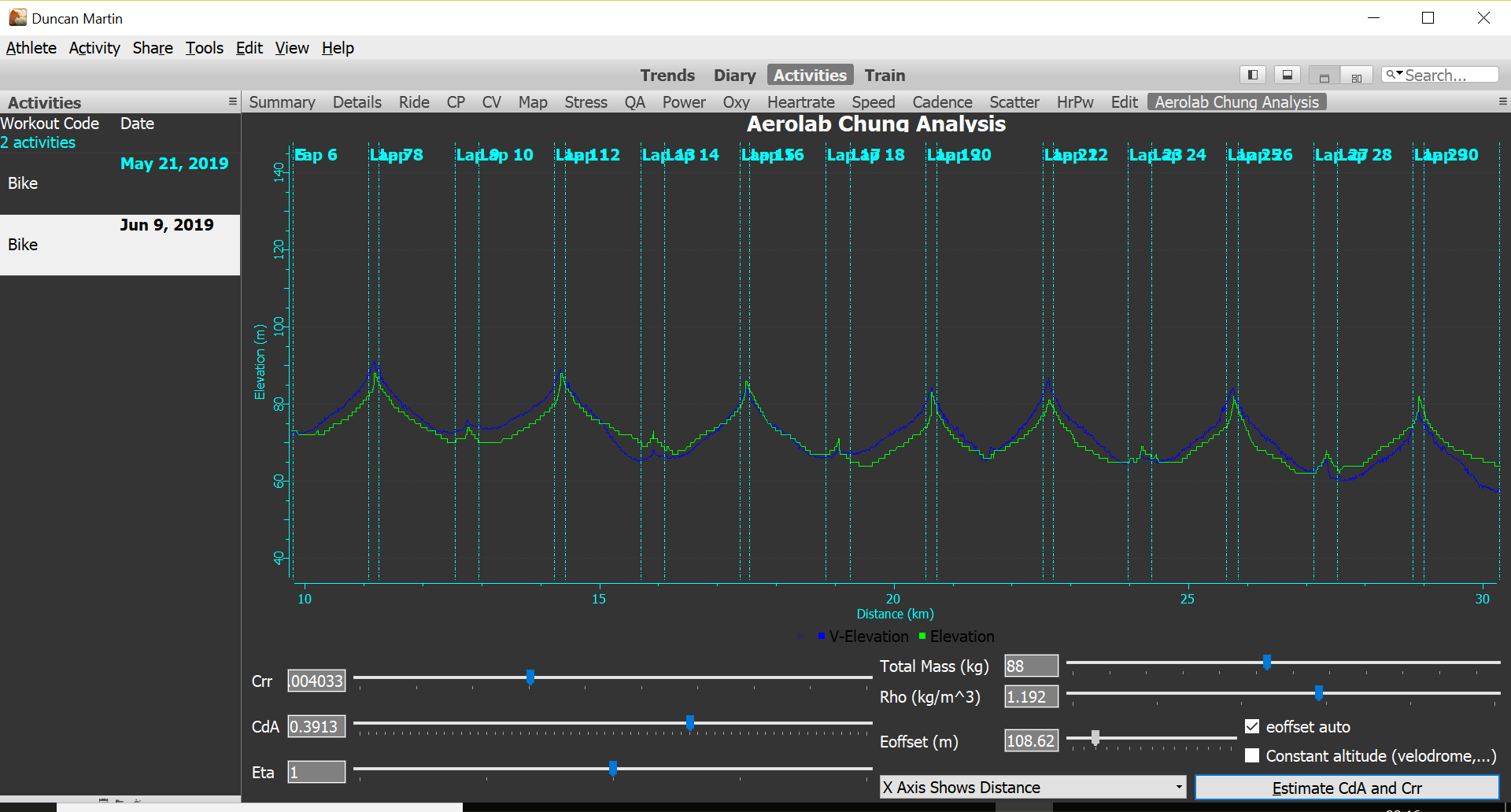
This is extremely rough, but there’s not much point in trying to be accurate given the other noise factors. The crucial data to interpret the above even a little is:
Flat – laps 6, 8,10,12
Steep- 14, 16
Mid height 18, 22, 24, 26
Flat again 28, 30.
Essentially, if I move the CdA slider slightly up then I match the steep and mid bar positions better, and if I move the slider slightly down then I match the flat bar position slightly better. In theory, this means that my original bar position was better, but in practise, as I said – too many variables. The absolute numbers are terrible – properly optimised TTers are around 0.20, but I’ve no idea how representative this is as it’s so rough and ready.
Lessons learned
Choose a better road!
The section I chose was relatively straight and the aim was to do a number of out-and-back runs, using the lap button to mark where each run began and ended. I used some chunky chalk to put some start/finish lines at each end of my run (on both sides of the road so I could see them). While this was actually reasonably successful, I started it up a slight hill, which meant I was dying as I got there – in retrospect I could have gone 100m further down the road and it would have been a lot easier! Also, there was quite a lot of traffic – while my testing is really coarse grained and so I don’t think this affected my results, if I had been testing smaller changes then the noise would have completely messed up the experiment.
Do more runs
The data only really becomes useful when you can put together a number of laps for each configuration, only a couple of laps just isn’t enough to deal with the noise.
Get the speed sensor working
Yet another issue with the data is that the speed data is a bit iffy. I couldn’t make my speed sensor work with my head unit, so I ended up relying on GPS speed data – while it isn’t a disaster for messing around, for real testing then a speed sensor is highly recommended, and seeing as I have one, it seems daft not to use it!
Record the barometric pressure as soon as you get home
This helps when calculating Rho, which is an important part of working backward to CdA. f you don’t do that then you have to rely on historical weather station data, and there isn’t one nearby that has this data.
Conclusions
I definitely want to try this again, properly. That means organising where I’m going, making my equipment set up all ready, avoiding a time when there is significant traffic, and having a lot more time to do lap after lap. I should probably read more about aerolab as well! At least I can do that without having to get out and ride back and forth on the same bit of road 15 times! It also means really focusing on ways of getting more aero, because at the moment it seems I’m a housebrick!
 Fixed TTing